
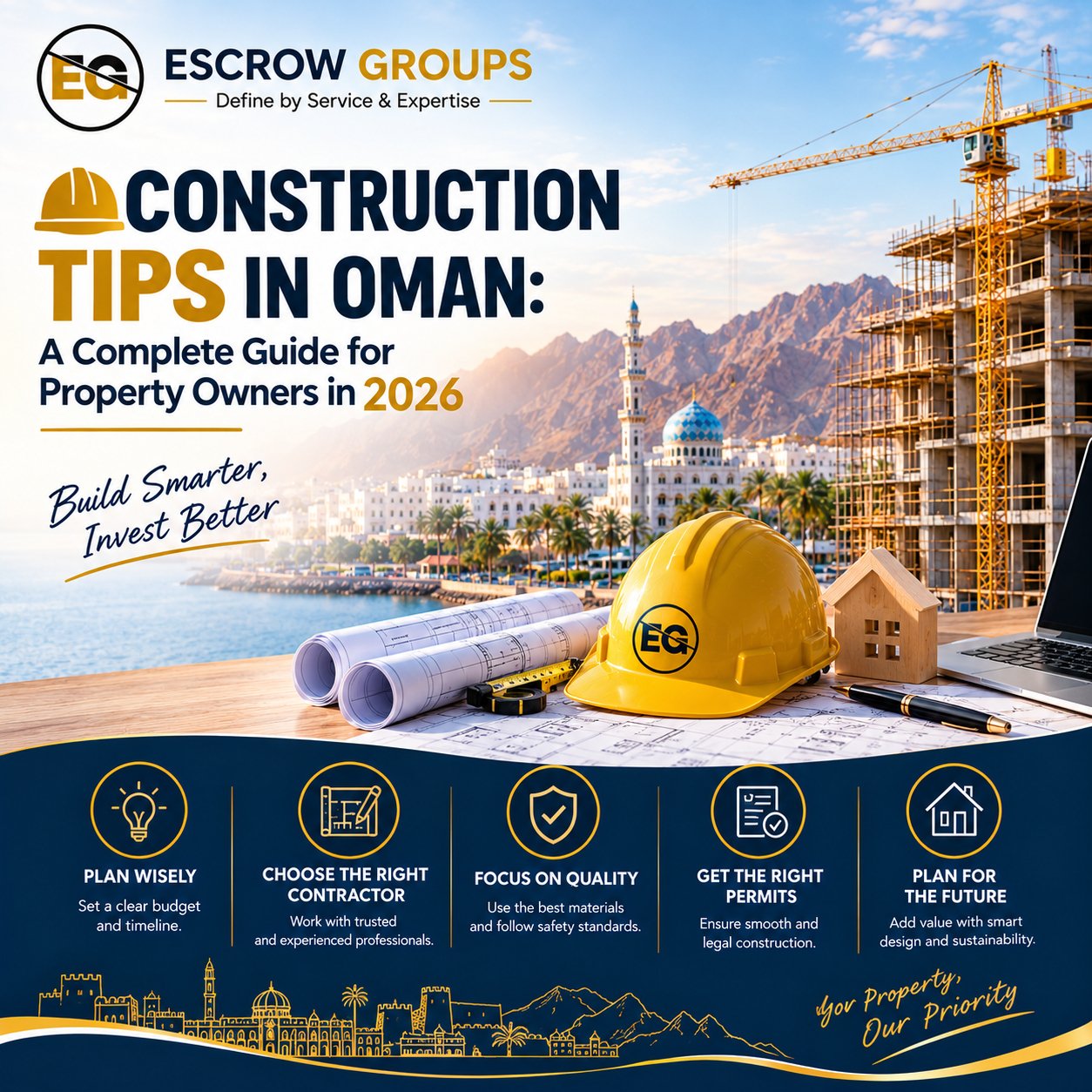
Construction Tips in Oman: A Complete Guide for Property Owners in 2026
Planning to build a villa, commercial building, shop, office or investment property in Oman? Construction is a major investment, and small planning mistakes can sometimes lead to higher costs, delays and unnecessary maintenance in the future.
Whether you are constructing a property in Muscat, Al Khoudh, Seeb, Mabela or another growing area of Oman, proper planning should come before construction work begins.
In 2026, construction planning is becoming increasingly important as Oman continues to focus on sustainable cities, infrastructure development, private-sector investment and better use of land under Oman Vision 2040.
Here are the most important construction tips for property owners in Oman to help you plan your project more efficiently.
1. Start With Proper Land and Site Assessment
Before starting any construction project, understand the land you are planning to build on.
A proper site assessment can help identify potential issues before construction begins.
Check:
- Land boundaries and measurements
- Site accessibility
- Road access
- Existing utilities
- Ground conditions
- Drainage requirements
- Surrounding development
- Applicable building restrictions
- Future development potential
For larger or more complex projects, professional technical and engineering assessments can help identify risks at an early stage.
Tip: Never finalize a construction design without understanding the actual site conditions.
2. Get the Required Building Approvals
One of the most important construction tips in Oman is to complete the required approvals before starting work.
For projects in Muscat, the official building permit process requires technical project documents, relevant approvals, land ownership or usufruct documentation, a site plan, identity documents and a consultant’s letter, among other requirements.
The exact requirements can vary depending on the project, location and type of building.
A major building permit must be obtained before applying for the construction commencement permit in Muscat. The commencement process can also require documents such as the cadastral drawing, site plan, land ownership and building permit.
Why this matters: Starting construction without completing the applicable approvals can create avoidable legal, financial and scheduling problems.
3. Choose the Right Architect and Consultant
A good construction project starts with good planning.
Your architect and engineering consultant can influence:
- Building design
- Structural safety
- Space utilization
- Electrical planning
- Plumbing
- HVAC requirements
- Material specifications
- Construction drawings
- Project approvals
Do not select a consultant based only on the lowest price.
Instead, consider their relevant experience, technical capability, communication and understanding of local requirements.
For a property investment project, your consultant should also understand how the building will be used. A residential villa, office building, retail property and industrial facility have different design and operational requirements.
4. Prepare a Realistic Construction Budget
One of the biggest construction mistakes is preparing a budget based only on the basic construction cost.
Your total project budget may also need to account for:
- Architectural and consultancy fees
- Government and approval-related costs
- Site preparation
- Excavation
- Structural work
- Electrical work
- Plumbing
- Air conditioning
- Doors and windows
- Flooring
- Painting
- Landscaping
- External works
- Security systems
- Fixtures and fittings
- Professional inspections
- Contingency costs
Create a detailed budget before construction begins.
It is also sensible to maintain a contingency allowance for unexpected site conditions or changes.
5. Do Not Compromise on Structural Quality
A building may look attractive from the outside, but its long-term performance depends heavily on what is inside the structure.
Structural work should receive careful attention, including:
- Foundation
- Reinforcement
- Concrete quality
- Columns
- Beams
- Slabs
- Waterproofing
- Load requirements
Quality should be checked at different construction stages rather than only when the building is almost complete.
A professional project team should follow approved drawings, specifications and applicable technical requirements.
Remember: Saving money by compromising critical construction quality can create much higher costs later.
6. Consider Oman’s Climate When Designing the Building
Oman has a hot and challenging climate, so climate-responsive construction should be considered from the planning stage.
A well-planned building can focus on:
- Efficient insulation
- Appropriate glazing
- Shading
- Proper ventilation
- Energy-efficient cooling
- Roof treatment
- Waterproofing
- Durable exterior materials
For residential and commercial properties, thoughtful orientation and shading can also contribute to indoor comfort.
The goal is not simply to build a beautiful property but to create a building that remains functional and comfortable over time.
7. Select Construction Materials Carefully
Construction materials have a direct impact on durability, appearance, maintenance and overall cost.
Instead of choosing materials only because they are inexpensive, compare them based on:
Quality + Durability + Maintenance + Availability + Cost
For example, materials used in external areas should be suitable for the local environmental conditions.
Before purchasing large quantities, confirm:
- Product specifications
- Quality standards
- Supplier reliability
- Warranty
- Availability
- Delivery schedule
A reliable supplier can also help reduce interruptions during construction.
8. Create a Clear Construction Timeline
Construction delays can increase labour, equipment and financing costs.
Create a realistic project schedule covering major stages such as:
Planning → Approvals → Site Preparation → Foundation → Structure → MEP → Finishing → Inspection → Handover
Your construction team should regularly compare actual progress with the planned schedule.
If a delay occurs, identify the reason immediately instead of allowing small delays to become major project problems.
Common causes of delays can include:
- Material shortages
- Design changes
- Approval delays
- Poor coordination
- Labour availability
- Weather conditions
- Unexpected site conditions
9. Avoid Too Many Design Changes During Construction
Changing the design after construction has started can affect both the budget and timeline.
For example, changing room layouts, electrical points, plumbing locations, flooring or major structural elements during construction may require additional work.
Before construction begins, finalize as much as possible:
- Floor plans
- Elevations
- Electrical points
- Plumbing locations
- Door and window specifications
- Flooring
- Kitchen requirements
- Bathroom layouts
- Lighting
- Air-conditioning requirements
Some changes will naturally happen, but proper planning can minimize unnecessary modifications.
10. Focus on Project Management and Quality Control
Construction involves many moving parts.
Architects, consultants, contractors, suppliers, engineers and workers need to coordinate effectively.
Professional project management can help monitor:
- Work progress
- Material delivery
- Labour
- Budget
- Quality
- Safety
- Documentation
- Contractor coordination
Regular site inspections can also help identify issues before they become expensive to correct.
For property owners who cannot visit the construction site regularly, professional project management can provide additional oversight and reporting.
11. Plan for Long-Term Property Value
If you are constructing a property as an investment, think beyond the completion date.
Ask:
Who will use this property?
If it is a residential property, consider family requirements, parking, privacy and future maintenance.
For commercial property, consider visibility, accessibility, parking, customer movement and flexibility of space.
For an investment property, consider:
- Rental demand
- Operating costs
- Maintenance
- Property functionality
- Location
- Future development
- Potential resale demand
Construction should support the property’s long-term purpose, not just its appearance.
12. Think About Sustainability
Sustainability is becoming increasingly relevant to urban development in Oman.
Oman Vision 2040 identifies Development of Governorates and Sustainable Cities as a national priority, with objectives including smart, sustainable and vibrant cities, sustainable urban development and modern infrastructure.
For property owners, sustainability can be considered through:
- Energy-efficient systems
- Water-efficient fixtures
- Better insulation
- Natural lighting
- Efficient cooling
- Durable materials
- Smart building technologies
- Proper waste management
These features can potentially contribute to lower operating costs and better long-term property performance.
13. Keep Construction Documents Organized
Documentation is an often-overlooked part of construction.
Maintain records of:
- Approved drawings
- Building permits
- Contracts
- Invoices
- Material specifications
- Inspection reports
- Payment records
- Variation orders
- Warranties
- Completion documents
Keeping everything organized can make future maintenance, renovation and property management easier.
Final Thoughts
Successful construction in Oman starts long before the first brick is placed.
From site assessment and approvals to budgeting, design, materials, quality control and project management, every stage can influence the final result.
For property owners in Muscat and across Oman, the goal should be to create a property that is not only visually attractive but also safe, functional, durable and suitable for long-term use.
Oman’s focus on sustainable cities, infrastructure and private-sector development under Vision 2040 also makes thoughtful construction and responsible land development increasingly important.
Whether you are planning a residential villa, commercial building, office, retail space or larger development, professional planning can help you manage the project more effectively.
Build with a plan. Build with quality. Build for the future.
