
Construction in Muscat, Oman: The Complete Guide to Choosing a Building Contractor
Building a property in Muscat requires more than a good design. Choosing the right contractor can mean the difference between a smooth project and costly delays or defects. This guide walks Oman-based homeowners and investors through every step: verifying contractor licenses and experience, checking portfolios and permits, understanding payment schedules and warranties, and managing risks (especially for overseas owners). It includes a checklist, a comparison table of key factors, a sample contract/payment schedule outline, local permit notes and FAQs – all tailored to Oman’s requirements. Follow these steps to hire a reliable contractor and protect your investment.
Why Contractor Selection Matters in Oman
Constructing a home, villa or commercial building in Muscat involves significant time and money. A licensed, experienced building contractor is crucial for:
- Quality and safety: Oman’s building code (2019) and Vision 2040 emphasize safe, sustainable construction. A good contractor follows technical specifications and safety regulations.
- Regulatory compliance: The right contractor knows local processes, from Muscat Municipality building permits to final inspections. Mistakes or illegal work can lead to fines or demolition.
- Cost control: Well-managed projects avoid overruns. Reputable contractors quote realistic budgets and handle variations professionally.
- Timely completion: Delays cost money. Contractors with proven schedules and project management can stay on track.
Hiring an unqualified contractor (or none at all) is a common cause of construction disputes. In Oman’s legal framework, the contract is key. Investors (especially overseas) should ensure the contractor’s credentials and contract terms protect their interests.
Contractor Selection Checklist (Step-by-Step)
Verify Contractor License and Classification:
Check that the contractor is registered with Oman’s authorities. In Muscat, contractors must have a valid municipality or Ministry of Housing licence for the project type (residential, commercial, etc.).Ask for their license number and category. Larger projects may require a higher-grade licence (some municipalities classify contractors by project size or specialization.
Red flag: No licence, or licence outside the required category.
-
Review Experience and Portfolio:
Examine the contractor’s track record. Have they completed projects of similar size and complexity?
Request a portfolio of past projects (villas, apartments, commercial buildings) in Muscat or Oman. Look for evidence of quality finishes and adherence to plans.
Ask for references or photos of completed work. Speaking to previous clients can reveal reliability and workmanship.
Red flag: Incomplete portfolio or inability to show finished examples of similar projects.
-
Check Permits and Regulatory Compliance:
Ensure the contractor is familiar with Muscat’s permit process. They should arrange or assist with required approvals (e.g. building permit, commencement permit, utility connections).
Confirm they have never had major compliance violations.
Red flag: Contractor promises to “handle permits” but lacks documentation or offers to proceed without official permits.
-
Assess Financial Stability and Business Structure:
Ask if the contractor is a sole proprietorship, LLC, or larger firm. Registered companies offer more accountability.
Check if they have adequate capital or backing. Financially weak contractors may cut corners or delay work.
Red flag: Contractor refuses to provide basic company details or is insolvent.
Insurance and Bonds:
Inquire about insurance coverage (worker injury, liability). Verify it’s current and sufficient. Contractors should carry workmen’s compensation and third-party liability insurance.
For larger projects, Oman often requires a performance bond or bank guarantee before starting work (especially government projects). Ask if they are prepared to issue one.
Red flag: No insurance or unwillingness to provide a performance guarantee.
-
Site Supervision and Subcontractors:
Confirm who will manage the project on-site. A qualified site engineer or supervisor should be present regularly.
If the contractor uses subcontractors (for plumbing, electrical, etc.), check that those specialists are also certified. Ensure the contractor remains responsible for all sub-work.
Red flag: No dedicated site supervisor, or reluctance to disclose subcontractors.
-
Quality Assurance and Warranties:
Ask about materials and workmanship standards. Will they follow approved drawings and technical specs?
Confirm warranties on work. Commonly, contractors offer a 1-year warranty on structure and finishes. Specify defect liabilities in the contract.
Red flag: No clear warranties or reluctance to sign off on quality guarantees.
Payment Schedule and Financial Terms:
Negotiate a detailed payment schedule. Typically: initial deposit (5–10%), progress payments at agreed milestones (e.g. excavation completion, structure completion), and a final payment or retention (often 5–10%) after handover.
Keep a retention amount or holdback to ensure any defects are fixed.
Red flag: Contractor demands large upfront payment (over 15–20%) or refuses to tie payments to progress.
-
Contract Terms and Dispute Resolution:
Use a written contract covering scope, timelines, payment terms, change-order process, and dispute resolution (preferably referencing Oman law or arbitration).
Ensure the contract is bilingual (English/Arabic) if needed.
Red flag: No formal contract, verbal agreements only, or ambiguous terms.
-
Communication and Reporting:
- Agree on reporting frequency (weekly photos/updates, formal progress reports).
- The contractor should be responsive, giving a local office address and point of contact.
- Red flag: Difficulty reaching the contractor or lack of transparency about progress.
A clear checklist keeps both owner and contractor accountable. Don’t rush to the cheapest option; weigh all factors for best value and peace of mind.
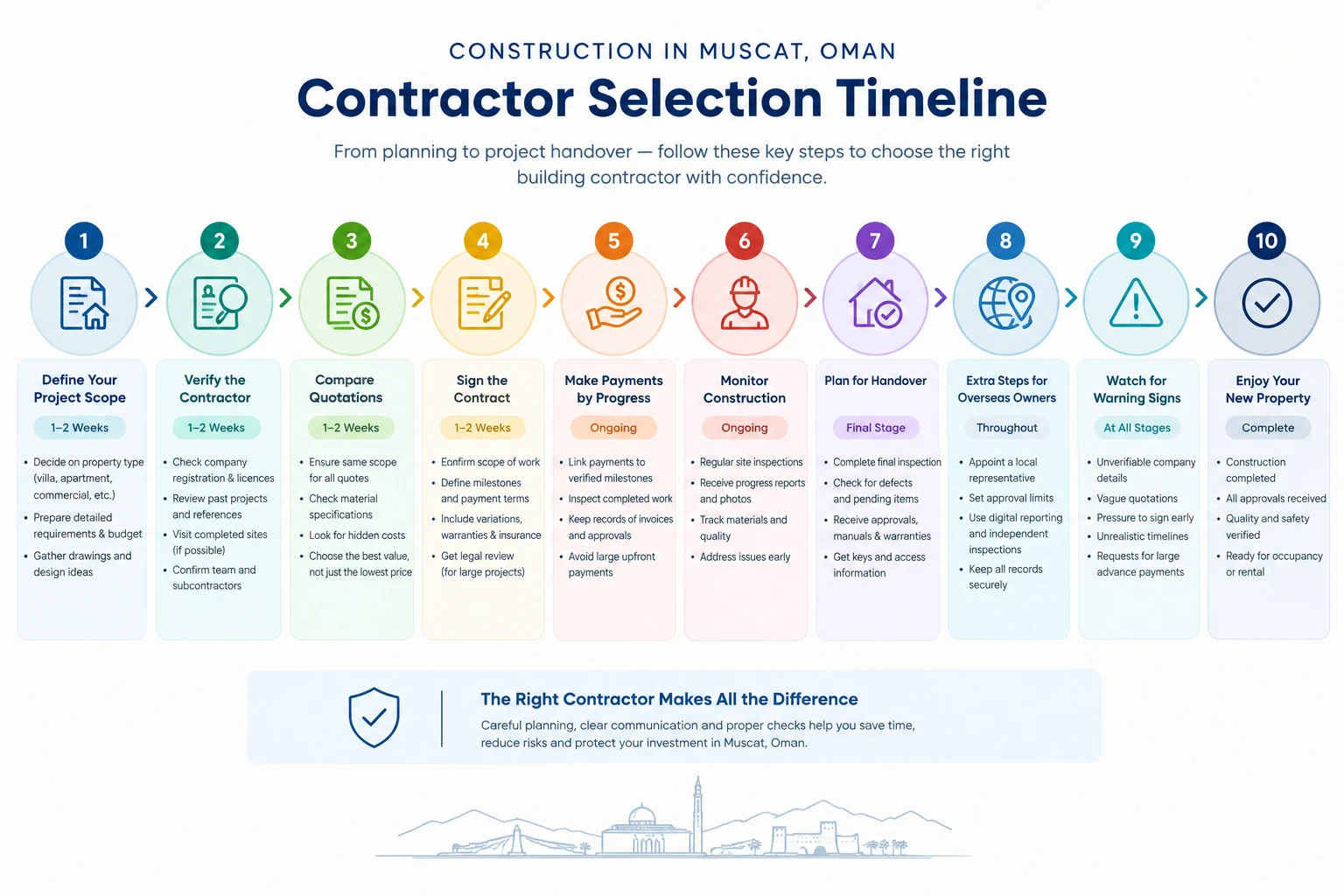
Contractor Selection Timeline (Example)
Comparison Table: Selecting a Contractor
| Factor | What to Check | Red Flags |
|---|---|---|
| License & Registration | Valid Oman license (category matches project); municipal approval | Unlicensed contractor; incorrect category |
| Experience & Portfolio | Similar completed projects in Muscat/Oman; client references | No similar projects; no references |
| Insurance & Bonds | Up-to-date worker and liability insurance; performance bond capability | No insurance; refusal to issue bond |
| Subcontractors | Qualified subcontractors for specialized work; contractor manages them | Unvetted subs; unclear subcontractor roles |
| Site Supervision | Dedicated site engineer/manager; regular oversight | No dedicated supervisor; part-time management |
| Payment Terms | Fair schedule (e.g. deposit + milestones + final retention) | Large upfront payment; no retention |
| Contract Clarity | Written contract with scope, timeline, change process, dispute clause | No formal contract; vague terms |
| Warranties & QC | Clear defect liability period (e.g. 1-year); quality check processes | No warranty; no quality inspection plan |
| Communication | Responsive communication; regular progress updates | Hard to reach; no documentation of progress |
| Cost vs Scope | Transparent pricing per scope item; detailed breakdown | Low bid with missing scope; constant extra charges |
Sample Contract and Payment Schedule
A simple contract outline and payment plan might look like:
- Contract Clauses: Parties’ details, project description, scope of work (with drawings as Annex), timeline, payment terms, defect liability, insurance, force majeure, dispute resolution.
- Payment Schedule (example):
- 5–10% deposit upon contract signing (after permits obtained).
- 20% upon completion of foundations and ground floor slab.
- 20% at roof-level structure complete.
- 20% at completion of brickwork and roofing.
- 20% after finishing (tiles, paint, etc.).
- Final 10% (or retention) after final inspection and handover.
- Change Orders: Document any scope changes with additional costs and time. Both sides approve in writing.
This structured schedule ties payments to visible milestones. It protects the owner from overpayment and incentivizes the contractor to progress as promised.
Local Permits and Licensing Notes
- Building Permit: In Muscat, you must obtain a building permit before construction. The contractor often submits this with technical drawings. The permit process requires approved plans, land title, survey, consultant letter, etc. (See Muscat Municipality guidelines).
- Contractor Registration: Often, to even apply for certain permits, the contractor must be officially registered with local authorities (Muscat Municipality or MOHUP) for that project type. Verify this in advance.
- Commencement Permit: After receiving the building permit, a separate Commencement of Property Construction permit is required before breaking ground.
- Approval Process: These steps are governed by Oman’s building regulations (Executive Regulations to the Housing Law). Fees vary by building size (ministerial decision updates fees periodically).
- Oman Building Code: Contractors and engineers must follow the Oman Building Code (last major update 2019), which includes standards for structure, fire safety, energy, accessibility, etc.
For authoritative details, consult the Ministry’s Building Code documents or the Muscat Governorate’s procedures. If uncertain, hiring a local consultant (architect/engineer) to handle permits can be worth the cost.
Risk Management for Overseas Owners
International investors face extra challenges. Here are additional precautions:
- Local Representative: Nominate a trusted agent (lawyer, project manager or consultant) to oversee daily matters on your behalf. They can verify progress reports and paperwork.
- Power of Attorney: Give limited power of attorney for signing permits/contracts if you cannot be on site.
- Escrow Payments: Consider using an escrow arrangement (though this is uncommon locally) or at least confirm bank details for payments to ensure funds go to the correct entity.
- Documentation: Keep copies of all permits, contracts, receipts, and inspection reports. Store them digitally and with your agent.
- Legal Advice: Consult a local lawyer familiar with Omani construction law before signing the contract, to ensure it meets both parties’ obligations.
- Currency and Taxes: Understand tax implications in both Oman and your home country. Oman currently has no property tax, but capital gains or corporate taxes may apply depending on your status.
By proactively Property Management Services in Oman to manage these risks, overseas owners can help the project stay on track even from afar.
Frequently Asked Questions
1. Why do I need a licensed contractor in Muscat?
Licensed contractors are familiar with Oman’s building code and permit requirements. They ensure compliance with regulations, which minimizes legal issues and ensures safety standards are met. Unlicensed work risks fines or having to redo work.
2. How can I verify a contractor’s license in Oman?
Ask the contractor to show their official registration or license. You can also request a municipality-issued license or engineer’s confirmation. Some Emirate/Downtown Muscat municipalities maintain lists of approved contractors. Always check the license covers your project type.
3. What questions should I ask when interviewing contractors?
Key questions include: “Have you built projects like mine?”, “Can I see past project references?”, “Do you carry insurance and provide a performance bond?”, “What is your payment schedule?”, and “What warranties do you offer on your work?”
4. What if a contractor fails to complete the job?
A well-written contract with a termination clause and a performance bond (if provided) offers protection. Also, keep a retention payment that you pay only after satisfactory completion. If disputes arise, Omani law can settle contract breaches, but legal processes take time and cost money, so prevention is best.
5. How much should I pay upfront vs. over time?
A common approach is ~10% deposit, then progress payments: 20–25% at structural milestones, and hold 10% until final handover. Exact terms vary, but avoid paying more than 15–20% before seeing significant progress. Always tie payments to completed work.
6. Can I manage the construction myself?
You can, but it’s risky unless you have Property Construction Services in Oman construction management experience. Even owners need a qualified engineer or project manager to supervise technical aspects. Hiring a contractor doesn’t eliminate your oversight—stay informed and involved, but delegate day-to-day management to professionals.
Build Smart, Build Safe: Choosing the right contractor in Oman means careful vetting and clear agreements. By following this guide’s checklist and tips, you’ll be better equipped to start construction with confidence.
Looking for Construction or Management Support in Oman? ESCROW GROUPS offers Property Construction in Oman and management services tailored to Oman’s market. Contact us to discuss your project needs and ensure a professional approach from planning to completion.
